
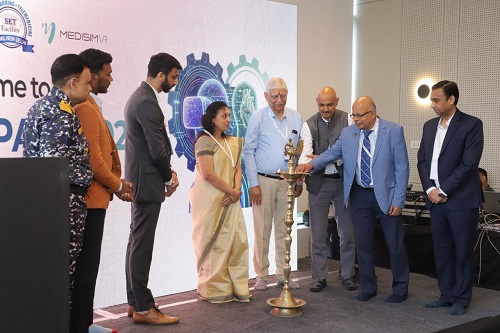
SIMPACT 2026, a national symposium focused on the future of healthcare training and competency-based education, convened in New Delhi through a collaborative effort between the Healthcare Sector Skill Council (HSSC), the SET Facility at AIIMS Delhi, and MediSim VR.
 |
SIMPACT 2026 Brings Together National Healthcare Leaders to Advance Simulation-Based Healthcare Education in India
The event brought together leading healthcare educators, policymakers, clinicians, and simulation experts to explore how simulation-based training and immersive technologies, including artificial intelligence (AI) and virtual reality (VR), can strengthen clinical competency and enhance workforce preparedness across India’s healthcare ecosystem.
Hosted at the Healthcare Sector Skill Council in New Delhi, the event featured keynote addresses, expert panel discussions, and a live demonstration of immersive simulation training at the Advanced Technology Centre (ATC) Lab. Attendees experienced a VR-based learning environment designed to support clinical skill development in controlled, repeatable settings.
SIMPACT 2026 was honored by the presence of distinguished chief guests: Dr. Ambuj Roy, Professor of Cardiology and Head of SET Facility, AIIMS Delhi, and Dr. V N Mahalakshmi, Vice Chancellor, Santosh Deemed-to-be-University, both of whom addressed the attendees and shared key insights on the role of simulation in advancing healthcare education. The event was also graced by the Guest of Honor, Dr. Manish Honwad, Surgeon Rear Admiral, VSM, Commanding Officer, INHS Asvini, who shared perspectives on scaling healthcare skill training across civilians and defense healthcare systems.
The speaker lineup featured a distinguished group of national healthcare leaders and simulation experts, including Ashish Jain, CEO, Healthcare Sector Skill Council; Dr. Rashmi Ramachandran, Professor, Department of Anaesthesiology, Pain Medicine & Critical Care, AIIMS Delhi; Dr. Dinker Pai, Director of the Medical Simulation Centre & Professor of Surgery, Mahatma Gandhi Medical College and Research Centre, and Dr. Adith Chinnaswami, Organizing Sectary, SIMPACT 2026, Co-founder & COO, MediSim VR.
The symposium further included insights from panel experts such as Dr. Rajesh Kumar Sharma, Professor and Head of the Department of Critical Care Nursing, Himalayan Institute of Medical Sciences; Dr. Lekha Viswanath, Principal, Nursing College & Deputy Director, Nursing Service, Amrita Vishwa Vidyapeetham; Col. Binu Sharma, Executive Director, Lone Star. CEO INS India; Dr. Anu Gauba, Principal-cum-Professor, Department of Nursing, School of Healthcare and Allied Sciences, GD Goenka University; Ms. Ekta Malik, Chief of Academic Initiatives and Simulation, Ebekmed; Ms. Robia Chacko, Manager: Training and Quality, Vidyanta; Ms. Anshu Verma, Assistant General Manager, Healthcare Sector Skill Council; and Mr. Unnikrishnan, Deputy Nursing Superintendent: Academics, Quality and Critical Care, Sarvodaya Healthcare.
Discussions at SIMPACT 2026 centered on three key themes: enabling Competency-Based Medical & Nursing Education through simulation, addressing the gap between simulation infrastructure and measurable learning outcomes, and scaling advanced simulation technologies to meet the demands of India’s growing healthcare workforce.
As India continues to expand its capacity in healthcare education and delivery systems, simulation-based learning is increasingly recognized as a foundational component of modern clinical training. AI-enabled immersive platforms enable healthcare professionals to practice procedures, refine clinical decision-making, and engage in complex scenarios in safe, standardized, and repeatable environments, thereby reducing patient risk and improving readiness.
Ashish Jain, CEO, Healthcare Sector Skill Council, underscored the role of technology in workforce development, “As India expands its healthcare delivery systems, maintaining consistent training standards becomes critical. “Simulation and immersive technologies offer scalable solutions to strengthen skill development and workforce readiness.”
Dr. Ambuj Roy, Professor of Cardiology & Head of the SET Facility, AIIMS Delhi, noted the increasing importance of simulation in high-acuity disciplines, “Simulation enables clinicians to rehearse complex procedures and critical scenarios without patient risk. Its integration into medical education strengthens preparedness, team coordination, and patient safety.”
Dr. V N Mahalakshmi, Vice Chancellor, Santosh deemed-to-be University, stated, “Simulation is not a substitute for clinical experience.” It enables healthcare professionals to learn new skills and refine existing ones in a zero-risk immersive environment, ultimately improving patient care. Platforms like SIMPACT play a critical role in building awareness and enabling the structured adoption of advanced simulation training across healthcare education.
Dr. Manish Honwad, Surgeon Rear Admiral, VSM, Commanding Officer, INHS Asvini, noted, “In the armed forces, we rely on simulation to prepare for high-risk, high-stakes situations where there is no margin for error. Healthcare operates under similar pressures.
Integrating technologies such as virtual reality into medical training ensures professionals are better equipped, more confident, and ready to respond effectively when it matters most.”
Dr. Adith Chinnaswami, Organizing Secretary, SIMPACT 2026, Co-founder and COO, MediSim VR, emphasized the role of immersive technology in bridging training gaps. “Simulation creates a pathway between theoretical knowledge and clinical practice. With immersive technologies such as virtual reality, learners can repeatedly practice procedures and decision-making until competency is achieved, significantly improving training quality and consistency.”
SIMPACT 2026 reflects a growing national movement toward collaboration between academia, industry, and sector skill bodies to advance simulation-based healthcare education and build a future-ready healthcare workforce.